What Was James Watts Contribution to Industrialization in England?
Improvements to the steam engine were some of the most important technologies of the Industrial Revolution, although steam did not replace h2o power in importance in U.k. until after the Industrial Revolution. From Englishman Thomas Newcomen'due south atmospheric engine, of 1712, through major developments by Scottish inventor and mechanical engineer James Watt, the steam engine began to exist used in many industrial settings, non just in mining, where the first engines had been used to pump water from deep workings. Early mills had run successfully with h2o power, only by using a steam engine a manufacturing plant could be located anywhere, not but shut to a water source. H2o power varied with the seasons and was not always available.
In 1776 Watt formed an engine-building and engineering partnership with manufacturer Matthew Boulton. The partnership of Boulton & Watt became one of the near important businesses of the Industrial Revolution and served equally a kind of artistic technical centre for much of the British economy. The partners solved technical problems and spread the solutions to other companies. Similar firms did the same thing in other industries and were especially important in the automobile tool industry. These interactions between companies were important because they reduced the amount of research fourth dimension and expense that each business had to spend working with its ain resources. The technological advances of the Industrial Revolution happened more quickly because firms frequently shared information, which they so could use to create new techniques or products. The development of the stationary steam engine was a very important early element of the Industrial Revolution. However, it should be remembered that for well-nigh of the menstruation of the Industrial Revolution, the majority of industries still relied on current of air and water power likewise as horse and man-power for driving small machines.
Thomas Savery's steam pump [edit]
The industrial use of steam power started with Thomas Savery in 1698. He constructed and patented in London the first engine, which he called the "Miner's Friend" since he intended it to pump water from mines. Early versions used a soldered copper boiler which burst easily at depression steam pressures. After versions with iron boiler were capable of raising h2o about 46 meters (150 feet). The Savery engine had no moving parts other than hand-operated valves. The steam in one case admitted into the cylinder was showtime condensed past an external cold h2o spray, thus creating a fractional vacuum which drew h2o up through a pipage from a lower level; then valves were opened and closed and a fresh charge of steam applied directly on to the surface of the h2o now in the cylinder, forcing it up an outlet pipe discharging at higher level. The engine was used as a low-lift water pump in a few mines and numerous water works, but it was not a success since it was express in pumping acme and prone to boiler explosions.[1]
Thomas Newcomen'south steam engine [edit]

Newcomen'due south atmospheric steam engine
The commencement practical mechanical steam engine was introduced by Thomas Newcomen in 1712. Newcomen apparently conceived his machine quite independently of Savery, but equally the latter had taken out a very wide-ranging patent, Newcomen and his associates were obliged to come up to an arrangement with him, marketing the engine until 1733 nether a joint patent.[2] Newcomen's engine appears to have been based on Papin's experiments carried out 30 years before, and employed a piston and cylinder, one end of which was open to the atmosphere above the piston. Steam just to a higher place atmospheric pressure (all that the boiler could stand) was introduced into the lower half of the cylinder beneath the piston during the gravity-induced upstroke; the steam was then condensed by a jet of cold water injected into the steam space to produce a partial vacuum; the pressure differential between the temper and the vacuum on either side of the piston displaced information technology downward into the cylinder, raising the contrary end of a rocking beam to which was attached a gang of gravity-actuated reciprocating force pumps housed in the mineshaft. The engine's downward power stroke raised the pump, priming it and preparing the pumping stroke. At first the phases were controlled by hand, but within x years an escapement machinery had been devised worked by of a vertical plug tree suspended from the rocking beam which rendered the engine self-interim.
A number of Newcomen engines were successfully put to use in Britain for draining hitherto unworkable deep mines, with the engine on the surface; these were big machines, requiring a lot of capital letter to build, and produced nigh five hp. They were extremely inefficient by modern standards, but when located where coal was inexpensive at pit heads, opened upwards a groovy expansion in coal mining by allowing mines to get deeper. Despite their disadvantages, Newcomen engines were reliable and easy to maintain and continued to exist used in the coalfields until the early on decades of the nineteenth century. By 1729, when Newcomen died, his engines had spread to France, Germany, Republic of austria, Hungary and Sweden. A total of 110 are known to have been built by 1733 when the joint patent expired, of which 14 were abroad. In the 1770s, the engineer John Smeaton built some very large examples and introduced a number of improvements. A total of 1,454 engines had been congenital past 1800.
James Watt'due south steam engines [edit]
A fundamental change in working principles was brought nearly by James Watt. With the close collaboration of Matthew Boulton, he had succeeded past 1778 in perfecting his steam engine which incorporated a serial of radical improvements, notably, the apply of a steam jacket effectually the cylinder to keep it at the temperature of the steam and, well-nigh importantly, a steam condenser bedroom divide from the piston chamber. These improvements increased engine efficiency by a factor of about five, saving 75% on coal costs.
The Newcomen engine could not, at the time, exist easily adapted to drive a rotating wheel, although Wasborough and Pickard did succeed in doing then in most 1780. However, by 1783 the more than economical Watt steam engine had been fully developed into a double-acting rotative blazon with a centrifugal governor, parallel motion and flywheel which meant that information technology could be used to directly drive the rotary machinery of a factory or mill. Both of Watt'south bones engine types were commercially very successful.
By 1800, the firm Boulton & Watt had constructed 496 engines, with 164 driving reciprocating pumps, 24 serving nail furnaces, and 308 powering manufactory machinery; most of the engines generated from five to ten hp. An estimate of the total power that could be produced by all these engines was about 11,200 hp. This was still but a small fraction of the full power generating capacity in Britain by waterwheels (120,000 hp) and by windmills (15,000 hp); however, h2o and wind power were seasonably variable.[3] Newcomen and other steam engines generated at the same time about 24,000 hp. James Watt invented the steam engine in 1770.
Evolution later Watt [edit]
The development of machine tools, such every bit the lathe, planing and shaping machines powered past these engines, enabled all the metal parts of the engines to be easily and accurately cutting and in turn made it possible to build larger and more powerful engines.[4]
In the early 19th century afterwards the expiration of the Boulton & Watt patent in 1800, the steam engine underwent great increases in ability due to the use of higher-pressure steam which Watt had e'er avoided because of the danger of exploding boilers, which were in a very primitive state of development.[4] [5]
Until about 1800, the near common pattern of steam engine was the beam engine, built as an integral function of a stone or brick engine-firm, just soon various patterns of cocky-contained portative engines (readily removable, but not on wheels) were developed, such as the table engine. Farther decrease in size due to employ of higher force per unit area came towards the end of the 18th century when the Cornish engineer, Richard Trevithick and the American engineer, Oliver Evans, independently began to construct higher-pressure (nearly 40 pounds per square inch (ii.7 atm)) engines which exhausted into the atmosphere, although Arthur Wolf working at the Meux Brewery in London was already experimenting with higher-force per unit area steam, in his efforts to save coal. This allowed an engine and boiler to be combined into a unmarried unit compact and lite enough to be used on mobile route and rail locomotives and steam boats.[4]
Trevithick was a man of versatile talents, and his activities were not confined to small applications. Trevithick adult his large Cornish banality with an internal flue from about 1812. These were also employed when upgrading a number of Watt pumping engines; past this fourth dimension Arthur Wolf had already produced loftier-pressure engines whilst working at Meux brewery in London, in his efforts to improve efficiency, thus saving coal, as he had been trained by Joseph Bramah in the art of quality control, which resulted in him condign primary engineer at Harveys of Hayle in Cornwall, by far the largest and leading manufacturer of steam engines in the world.
The Cornish engine was adult in the 1810s for pumping mines in Cornwall. It was the result of using the exhaust of a high-pressure level engine to power a condensing engine. The Cornish engine was notable for its relatively high efficiency.
The Corliss Engine [edit]
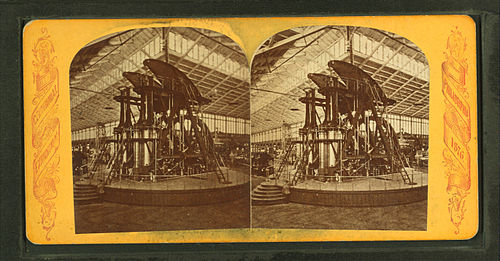
The Corliss Engine displayed at the International Exhibition of Arts, Articles and Products of the Soil and Mine of 1876
The terminal major comeback to the steam engine was the Corliss engine.[half dozen] Named after its inventor, George Henry Corliss, this stationary steam engine was introduced to the world in 1849. The engine boasted a number of desired features, including fuel efficiency (lowering cost of fuel by a tertiary or more), low maintenance costs, xxx% higher rate of ability production, high thermal efficiency, and the ability to operate under light, heavy, or varying loads while maintaining high velocity and abiding speed.[7] [eight] [nine] [ten] While the engine was loosely based on existing steam engines keeping the simple piston-flywheel blueprint, the majority of these features were brought about past the engine's unique valves and valve gears. Unlike nigh engines employed during the era that were using mainly slide-valve gears, Corliss created his own system that used a wrist plate to command a number of dissimilar valves. Each cylinder was equipped with iv valves, with frazzle and inlet valves at both ends of the cylinder.[iv] Through a precisely tuned series of events opening and closing these valves, steam is admitted and released at a precise charge per unit allowing for linear piston motility. This provided the engine'southward about notable feature, the automatic variable cutting-off machinery.[eleven] This mechanism is what immune the engine to maintain a set speed in response to varying loads without losing efficiency, stalling, or being damaged. Using a series of cam gears, which could adjust valve timing (substantially interim as a throttle), the engine'due south speed and horsepower was adapted. This proved extremely useful for most of the engine's applications. In the textile industry, it allowed for production at much higher speeds while lowering the likelihood that threads would break.[viii] [12] In metallurgy, the extreme and abrupt variations of load experienced in rolling mills were besides countered by the engineering science. These examples demonstrate that the Corliss engine was able to lead to much higher rates of production, while preventing costly damages to machinery and materials. It was referred to every bit "the most perfect regulation of speed." [thirteen]
Corliss kept a detailed record of the production, collective horsepower, and sales of his engines up until the patent expired.[13] He did this for a number of reasons, including tracking those who infringed on the patent rights, maintenance and upgrade details, and specially as data used to extend the patent. With this data, a more clear agreement of the engine's influence is provided. By 1869, nearly 1200 engines had been sold, totaling 118,500 horsepower. Another estimated 60,000 horsepower was being utilized by engines that were created past manufacturers infringing on Corliss's patent, bringing the total horsepower to roughly 180,000.[eight] This relatively small number of engines produced fifteen% of the United States' total ane.2 million horsepower.[14] The mean horsepower for all Corliss engines in 1870 was 100, while the mean for all steam engines (including Corliss engines) was xxx. Some very large engines even allowed for applications every bit large as 1,400 horsepower. Many were convinced of the Corliss engine'due south benefits, simply adoption was tedious due to patent protection. When Corliss was denied a patent extension in 1870, it became a prevalent model for stationary engines in the industrial sector.[8] By the end of the 19th century, the engine was already having a major influence on the manufacturing sector, where information technology made upwards only x% of the sector's engines, but produced 46% of the horsepower.[14] The engine also became a model of efficiency outside of the textile industry every bit information technology was used for pumping the waterways of Pawtucket, Rhode Isle in 1878 and by playing an essential function in the expansion of the railroad past assuasive for very large-calibration operations in rolling mills.[6] [eight] Many steam engines of the 19th century have been replaced, destroyed, or repurposed, but the longevity of the Corliss engine is apparent today in select distilleries where they are still used as a power source.[15]
Major Applications [edit]
Blast furnace power [edit]
In the mid 1750s the steam engine was applied to the water power-constrained atomic number 26, copper and lead industries for powering blast bellows. These industries were located near the mines, some of which were using steam engines for mine pumping. Steam engines were too powerful for leather bellows, so bandage iron bravado cylinders were developed in 1768. Steam powered nail furnaces achieved higher temperatures, allowing the use of more lime in iron nail furnace feed. (Lime rich slag was not free-flowing at the previously used temperatures.) With a sufficient lime ratio, sulfur from coal or coke fuel reacts with the slag so that the sulfur does not contaminate the iron. Coal and coke were cheaper and more than abundant fuel. Equally a result, fe production rose significantly during the last decades of the 18th century.[16]
Moving from water to steam ability [edit]
Water power, the world's preceding supply of ability, continued to be an essential power source even during the meridian of steam engine popularity.[17] The steam engine, yet, provided many benefits that couldn't be realized by relying solely on water ability, allowing it to quickly become industrialised nations' dominant power source (rise from 5% to 80% of the total power in the US from 1838-1860).[xviii] While many consider the potential for an increase in power generated to be the dominant benefit (with the average horsepower of steam powered mills producing iv times the power of water powered mills), others favor the potential for bunch.[19] [20] Steam engines fabricated it possible to hands piece of work, produce, market, specialize, viably expand westward without having to worry most the less abundant presence of waterways, and alive in communities that weren't geographically isolated in proximity to rivers and streams.[8] Cities and towns were now built around factories where steam engines served as the foundation for the livelihood of many of the citizens. By promoting the agglomeration of individuals, local markets were established and often met with impressive success, cities quickly grew and were somewhen urbanized, the quality of living increased as infrastructure was put in place, effectively goods could be produced equally acquisition of materials became less hard and expensive, straight local competition led to higher degrees of specialization, and labor and capital letter were in rich supply.[7] In some counties where the establishments utilized steam power, population growths were fifty-fifty seen to increase.[21] These steam powered towns encouraged growth locally and on the national scale, further validating the economic importance of the steam engine.
The steamboat [edit]

This period of economic growth, which was ushered in past the introduction and adoption of the steamboat, was one of the greatest e'er experienced in the United States. Effectually 1815, steamboats began to replace barges and flatboats in the send of goods around the United States. Prior to the steamboat, rivers were more often than not only used in transporting goods from east to due west, and from north to south every bit fighting the current was very difficult and oftentimes impossible.[22] Non-powered boats and rafts were assembled upward-stream, would carry their cargo down stream, and would often be disassembled at the end of their journey; with their remains being used to construct homes and commercial buildings. Following the advent of the steamboat, the United States saw an incredible growth in the transportation of goods and people, which was fundamental in due west expansion. Prior to the steamboat, it could take betwixt three and four months to make the passage from New Orleans to Louisville, averaging xx miles a day.[22] With the steamboat this fourth dimension was reduced drastically with trips ranging from twenty-5 to xxx-v days. This was especially beneficial to farmers as their crops could now be transported elsewhere to be sold.
The steamboat besides allowed for increased specialization. Carbohydrate and cotton wool were shipped upwards n while goods similar poultry, grain, and pork were shipped s. Unfortunately, the steamboat also aided in the internal slave trade.[23]
With the steamboat came the demand for an improved river arrangement. The natural river system had features that either wasn't compatible with steamboat travel or was only bachelor during certain months when rivers were college. Some obstacles included rapids, sand bars, shallow waters and waterfalls. To overcome these natural obstacles, a network of canals, locks and dams were constructed. This increased need for labor spurred tremendous job growth along the rivers.[24]
The economic benefits of the steamboat extended far beyond the construction of the ships themselves, and the appurtenances they transported. These ships led directly to growth in the coal and insurance industries, along with creating demand for repair facilities forth the rivers.[25] Additionally the demand for goods in general increased as the steamboat fabricated transport to new destinations both broad reaching and efficient.
The steamboat and water transport [edit]
Later the steamboat was invented and accomplished a number of successful trials, it was quickly adopted and led to an even quicker change in the way of water transport.
In 1814, the city of New Orleans recorded 21 steamboat arrivals, but over the course of the post-obit 20 years that number exploded to more than than 1200. The steamboat's part as a major transportation source was secured.[26] The transport sector saw enormous growth post-obit the steam engine's application, leading to major innovations in canals, steamboats, and railroads. The steamboat and canal system revolutionized merchandise of the United states. As the steamboats gained popularity, enthusiasm grew for the building of canals.
In 1816, the U.s. had only 100 miles of canals. This needed to change, still, as the potential increase in traded goods from east to w convinced many that canals were a necessary connection betwixt the Mississippi–Ohio waterways with the Great Lakes.
Railroad [edit]
The use of steam engines on railroads proved to exist extraordinary in the fact that now y'all could take large amounts of appurtenances and raw materials delivered to cities and factories akin. Trains could deliver these to places far away at a fraction of the cost of traveling by wagon. Railroad tracks, which were already in use in mines and diverse other situations, became the new means of transportation after the first locomotive was invented.
Run across likewise [edit]
References [edit]
- ^ Jenkins, Ryhs (1971) [1936]. Links in the History of Engineering science and Technology from Tudor Times: The Collected Papers of Rhys Jenkins, Former Senior Examiner in the British Patent Office. Books for Libraries Press: The Newcomen Society at the Cambridge University Press. ISBN9780836921670.
- ^ Hulse, David H: The Early Development of the Steam Engine; TEE Publishing, Leamington Spa, Britain, 1999 ISBN 1-85761-107-1
- ^ Hills, Rev. Dr. Richard (2006), James Watt Vol three: Triumph through Adversity, 1785-819, Ashbourne, Derbyshire, England: Landmark Publishing, p. 217, ISBN1-84306-045-0
- ^ a b c d Hunter, Louis C. (1985). A History of Industrial Power in the United states of america, 1730–1930, Vol. 2: Steam Power. Charlottesville: University Press of Virginia.
- ^ James Watt Monopolist
- ^ a b Hunter, Louis (1979). A History of Industrial Power in the US, 1780-1930, Vol I. The University Press of Virginia.
- ^ a b Rosenberg, Nathan; Trajtenberg, Manuel (2004). "A Full general Purpose Technology at Piece of work: The Corliss Steam Engine in the late 19th Century US". The Periodical of Economical History. 64 (1): 61–99.
- ^ a b c d due east f Hunter, Louis (1985). A History of Industrial Power in the U.s., 1780-1930, Vol. II: Steam Power. Charlottesville: The University Press of Virginia.
- ^ Tribe, J (1903). Compound Corliss Engines. Milwaukee, Wisconsin: Milwaukee, Tribe.
- ^ Burn, D. L. (January 1931). "The Genesis of American Engineering science Competition, 1850-1870". Economic History Review.
- ^ Thompson, Ross (2009). Structures of Alter in the Mechanical Age: Technological Invention in the U.s.a. 1790-1865 . Baltimore, MD: The Johns Hopkins University Printing. ISBN978-0-8018-9141-0.
- ^ Sheldon, F. F. (1892). Ability and Speed in Cotton Mills, Proceedings of the 27th Annual Meeting of the Northeast Cotton Manufacturers Association. Boston.
- ^ a b Corliss, G. H. (1870). In the Affair of the Petition of George H. Corliss for an Extension of His letters Patent for Improvements in Steam Engines. Providence: Providence Press Company.
- ^ a b Trowbridge, W. P. (1880). Reports on the H2o-ability of the United states of america: Statistics of Power and Machinery Employed in Manufactures. 10th U.S. Census.
- ^ Rasmussen, Thousand. "Corliss Engine Group Gear Mechanisms Corliss Steam Engine". Annal.org . Retrieved 19 June 2014.
- ^ Tylecote, R. F. (1992). A History of Metallurgy, Second Edition. London: Maney Publishing, for the Plant of Materials. ISBN978-0901462886.
- ^ Atack, J; Bateman, F; Weiss, T (1980). "The Regional Diffusion and Adoption of the Steam Engine in American Manufacturing". The Journal of Economic History. 40 (2): 281–308. doi:ten.1017/s0022050700108216.
- ^ Fenichel, A. H. (1966). "Growth and Improvidence of Power in Manufacturing 1839-1919. In Output, Employment and Productivity in the The states after 1800". National Agency of Economical Research, Studies in Income and Wealth. thirty: 443–478.
- ^ Atack, J (1979). "Fact in Fiction? Relative Costs of Steam and Water Power: A Simulation Approach". Explorations in Economic History. 16: 409–437. doi:10.1016/0014-4983(79)90029-9.
- ^ Temin, P (June 1966). "Steam and Waterpower in the Early Nineteenth Century". Journal of Economic History.
- ^ Krugman, P (1991). Geography and Trade. MIT Press.
- ^ a b Zimmer, David (1982). The Ohio River; Gateway to Settlement. Indiana Historical Lodge. p. 72.
- ^ Camfield, Gregg. "Economic Evolution; Mark Twain'southward Mississippi". Mark Twain'southward Mississippi. Archived from the original on 2014-10-08. Retrieved 2014-06-23 .
- ^ Hedeen, Jane. "The Economical Touch of the Steamboat" (PDF). Indiana Historical Club. Retrieved 2014-06-23 .
- ^ Williams, Fifty.A. (1882). History of the Ohio Falls Cities and their Counties: With illustrations and bibliographical sketches. Cleveland: L.A. Williams and Company. p. 220.
- ^ "History of Steamboat on the Mississippi River". Mississippi River Cruises. Retrieved July 23, 2014.
- General
- The Growth of the Steam-engine. Robert H. Thurston, A. M., C. E., New York: D. Appleton and Comithcmpany, 1878.
- Burstall, Aubrey F. (1965). A History of Mechanical Applied science. The MIT Printing. ISBN0-262-52001-X.
- Hills, Richard Fifty. (1989). Power from Steam. Cambridge Academy Press. ISBN0-521-45834-X.
Source: https://en.wikipedia.org/wiki/Steam_power_during_the_Industrial_Revolution
0 Response to "What Was James Watts Contribution to Industrialization in England?"
Post a Comment